
A resume that earns a second look.
Upload the resume you have and tell us the role you want next. We rewrite it around that role and save it to your account as a Word document, usually within five minutes.
A free resume builder (CV) that starts from your own experience
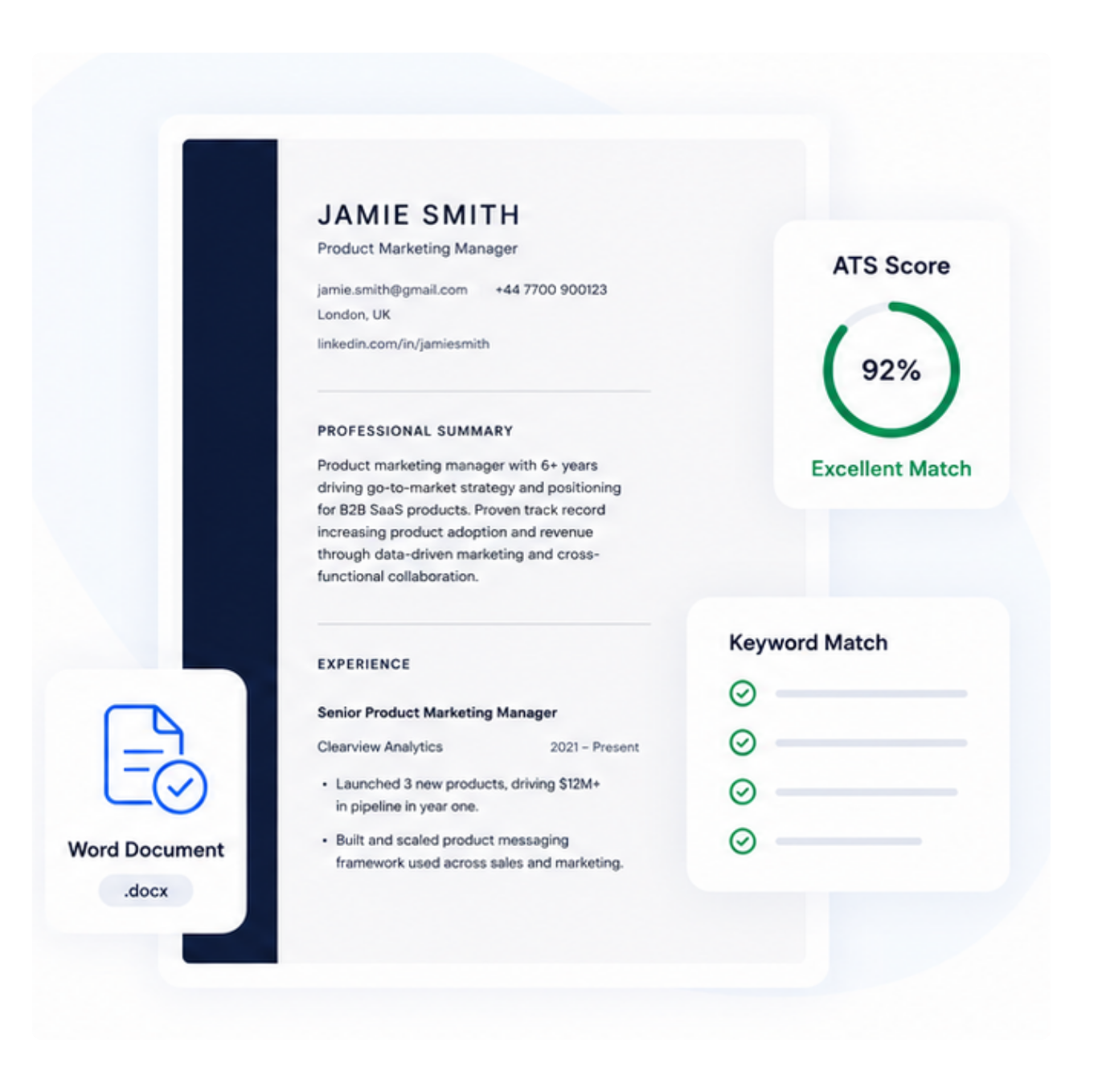
This free resume builder rewrites the resume you already have for the role you want next. Upload it as a PDF or Word file, add the target role and, if you have one, the job posting. You get an ATS-friendly Word document in your account, usually within five minutes. A free account includes three resumes.
Built for people with a real career behind them
The builder starts from your resume, not a blank template, so it does its best work with plenty of history.
- Experienced professionals. Every role stays in, most recent first. Older roles get shorter, not cut.
- Career changers. Name the role you are moving into and the builder orders your skills and wins around it. There is a box for the story behind the switch.
- People who have been laid off. A current, targeted resume the same day, free.
- Over-50s and long careers. Length follows your history, so nothing important gets squeezed onto one page.
- Anyone else with a role in mind, from a first management job to a return after a break.
What you get from the free resume builder
A finished resume in your account as a Word document, in one of three templates (Classical, Modern or Executive), ready to edit, save as a PDF and send:
- Your name and the contact details you choose to share.
- A two or three sentence summary aimed at the target role.
- Up to eight core skills, taken from what your resume shows and ordered for the role.
- Every role, most recent first, with one to three achievement bullets each, carrying a number wherever you gave us one.
- Your education and qualifications.
- A short note on how we wrote it, so you can judge the main choices.
Example: two bullets, before and after
Before (what you gave us)
'Ran the regional sales team (9 people). We grew revenue from $4.1M to $5.3M in two years.'
After
'Led a 9-person regional sales team that grew revenue from $4.1M to $5.3M in two years.'
Before
'In charge of supplier contracts and renewals for the Midwest stores.'
After
'Managed supplier contracts and renewals for the Midwest stores.'
How the resume builder works
Four steps. Three questions are required; the rest sharpen the result.
Create a free account.
Your resumes are saved there to download or revise later.
Upload your current resume.
PDF or Word, or paste the text. We pull out your roles, dates, education and skills.
Tell us where you are heading.
Target role, industry and seniority. Then, if you like, a job posting to aim at (the form shows which of its main keywords your resume already uses), a template, what to lead with, and US or British English.
Open the Word document.
We email you when it is in your account. Edit anything, save as a PDF, send, or ask for one of five free revisions.
Applying for one specific job? Apply to a role, in your account, writes a matched resume and cover letter together.
We don't invent numbers or experience
Every employer, title, date and number on your resume comes from what you give us. If a role has no figures, the bullet says what you did and stops. The skills list only includes skills your resume shows: a job posting changes which come first, never whether you have them. And we will not call an employer a 'startup' unless you do.
A made-up number is the hardest thing on a resume to defend in an interview, so everything here is yours to stand behind.
Standout never applies to jobs or posts on your behalf. You stay in control of every application and every post.
Resume questions, answered
Before you start.
Yes. A free account gets you three resumes, each with five free revisions, and no credit card is needed. If you want more, Standout Daily ($19.99 a month after a 7-day free trial) makes every tool unlimited.
Yes. It is built to be read cleanly by applicant tracking systems: standard section names, one column, no tables or graphics, which are the layouts Greenhouse lists as likely to parse badly. In a 2021 Harvard Business School and Accenture survey, 75% of US employers said they use recruiting management software.
Never. Numbers, employers, titles and dates come only from what you give us. Want a figure that isn't in your upload? Add it in the 'what to lead with' box or a revision request.
As long as your history needs: about a page early in a career, two or more for a long senior one, with older roles kept brief. MIT's career office advises one page unless you have extensive experience or an advanced degree. Applying for a federal job? USAJOBS limits resumes to two pages since September 27, 2025, so check the page count.
The builder keeps every role you upload and makes older ones brief. Career offices often advise detailing about the last 10 to 15 years (University of Colorado Boulder). To drop or merge your earliest roles, say so in the Additional context box.
There is no universal ATS score: each tool, ours included, calculates its own, so 80% only means something against that tool's method. Greenhouse says its resume-matching score is advisory and never rejects anyone on its own. Our form's check simply counts how many of the posting's most frequent words your resume uses.
You get Word, so you can edit it, then save it as a PDF. A Word file or a PDF exported from Word or Google Docs is accepted by the major systems; avoid scans and PDFs built in design tools, and follow the employer's stated format.
In the US the application document is a resume, and a CV usually means a longer academic, research or medical record. In the UK a CV is the standard application document. This builder writes the application kind, in US or British English. Your account and emails call it a CV either way.
Five free on every resume. Name what to change, a tighter summary or a corrected date, and the builder rewrites those sections and leaves the rest alone.
Read these before you send it
- How to make an ATS-friendly resume: what tracking systems do with your resume, and the layouts they read cleanly.
- How long should a resume be?: one page or two, and when longer is right.
- CV vs resume: what's the difference?: which word, and which document, where.